 Races
Races
Understand how hydration effects your running, and guidelines to optimize hydration to perform at your best in 10k to half-marathon distances
We all know good hydration helps in improved performance during the race. As 10K usually lasts closer to 60 min, the impact of dehydration may not be significant. However, in a half marathon, the time is more than 60 min and hence proper focus must be put on hydration.
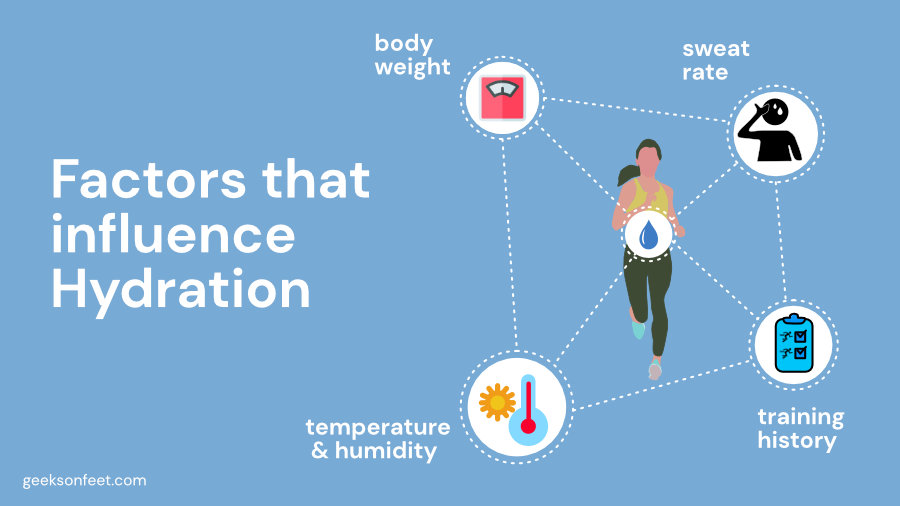
There are various factors that decide the hydration strategies such as Body weight, Sweat rate, Training or race day temperature and humidity and Training history.
This article provides broad guidelines for hydration and can be tailored for individual needs after assessment of various parameters.
Our body can be in three different states of hydration based on how we hydrate ourself before, during and after the race. Here is a quick summary of these states, how to identify which state we are in, and how that impacts performance.
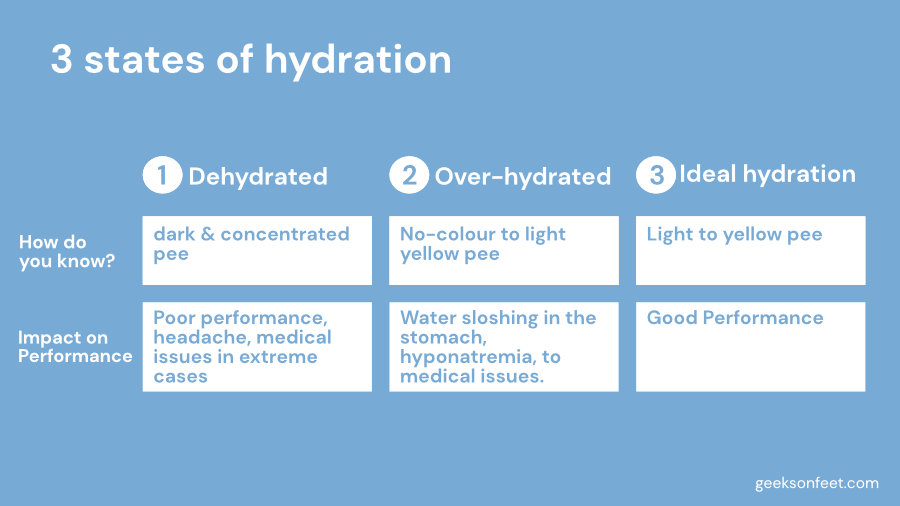
During most races and training days, light de-hydration is expected and it does not hamper performance. But we need to be careful of extreme dehydration or over-hydration.
There are 2 schools of thought on Hydration.
Both these thoughts have their merits. We will tread the middle path.
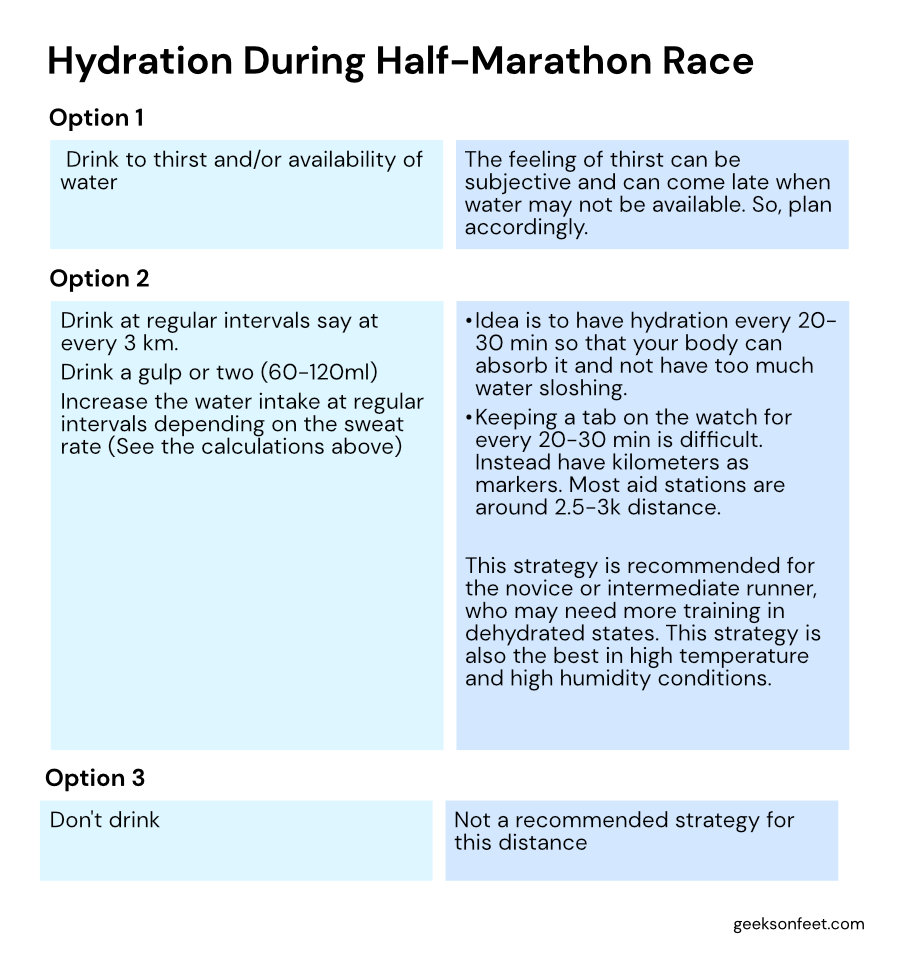
So here are our pointers, keeping in mind that good hydration practices during the training are very much recommended to prepare for race days.
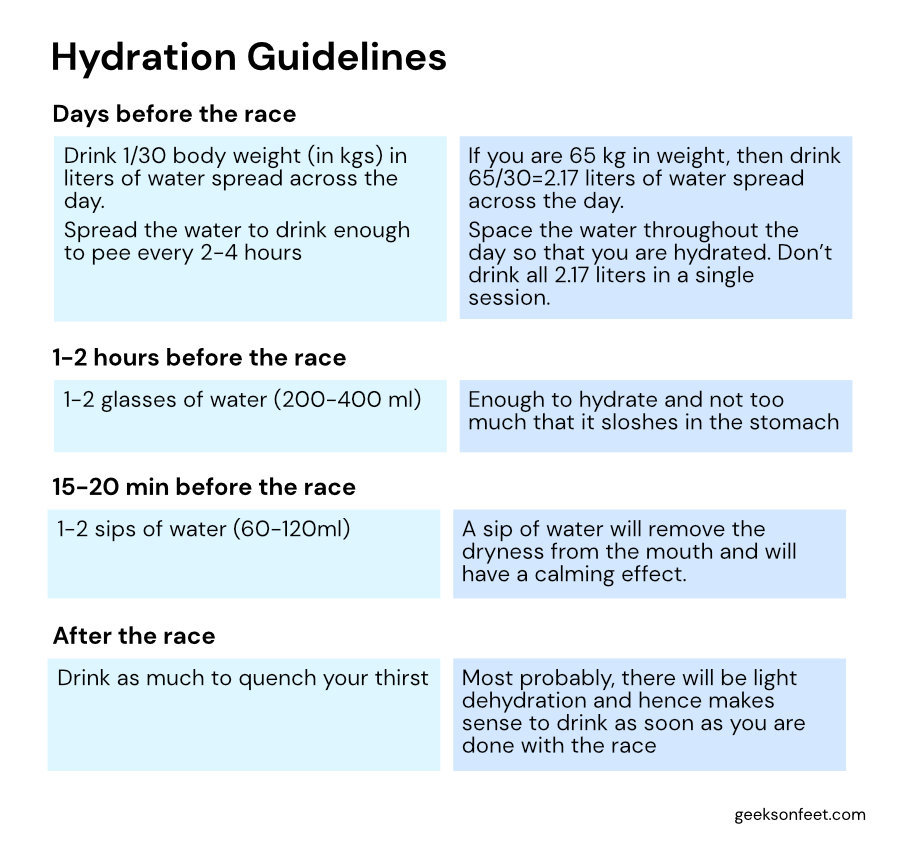
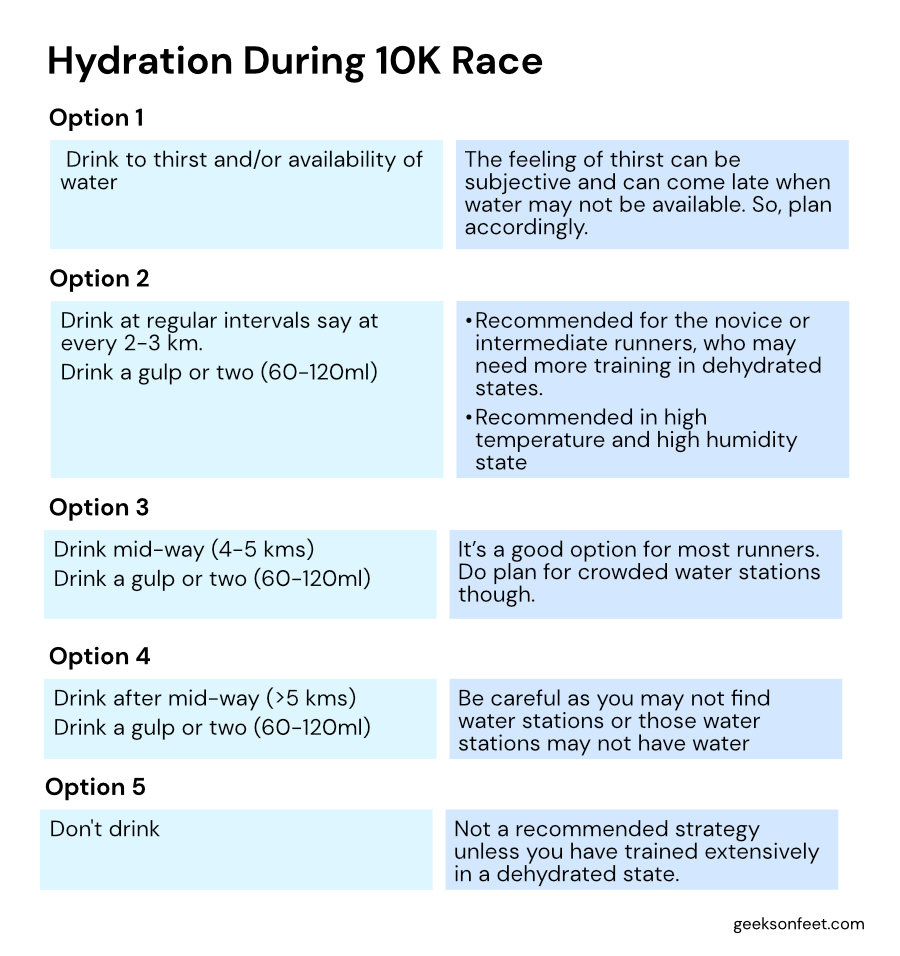
Before we delve into hydration for the half-marathon, we need to understand sweat rate. If we lose more water due to our sweat (and pee) than we are able to replace the water in our body (and cells), then we risk dehydration. Hence estimating our water loss due to sweat and pee becomes crucial at this point.


Here is how you can estimate water loss per hour due to your sweat and pee (during the training or race)
1 kilo of water = 1 litre of water in volume.
Water loss (due to sweat or pee) = Weight before workout + any water or food consumed – weight after workout.
Water loss rate = Water loss / Total time taken for workout
Water loss = 65 (Bodyweight) + 0.5 (0.5 litre of water) + 0.2 (bananas) – 64 = 1.7 kilos
Water loss rate = 1.7 / 1.5 = 1.13 kilo/hour (or) approximately 1.13 litre per hour (or) 0.28 litre per 15 min. In short, around 300 ml per 15 min.
Based on the above calculation, one has to consume 300ml of hydration every 15 min.
It might be difficult to increase 300 ml of water suddenly and so quickly. So one has to phase out the water consumption in a gradual manner – one gulp at a time every 15-20 min.
There are 3 concentrations of water that can impact the level of hydration in your body.
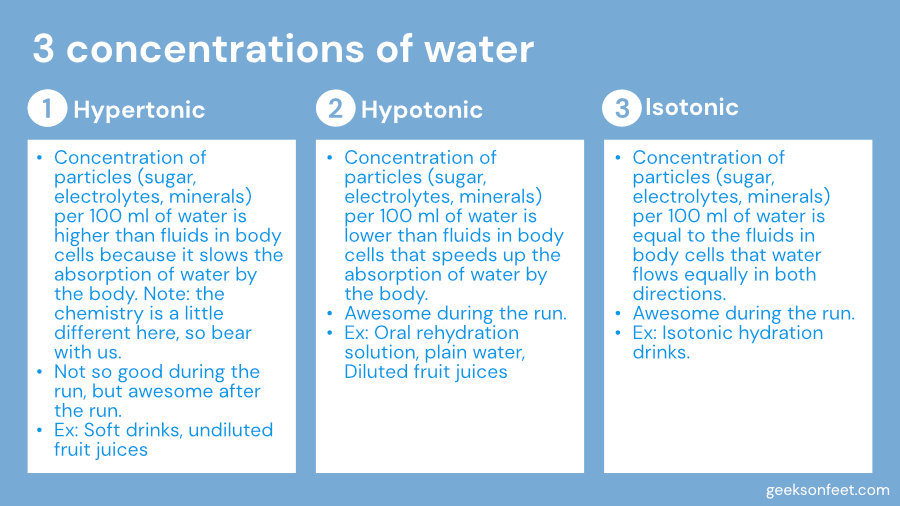
From the above table, you might ask, why not drink plain water to ensure maximum hydration. In the 3 states of hydration, we talked about over-hydration that can lead to salt imbalances in our body causing hyponatremia. So our water must have enough salt and other minerals to balance the salt inside our cells in the body.
We can play with the concentration of water by adding ‘salts’ to it. Adding a pinch of salt (NaCl or Sodium Chloride) is good to make the water hypotonic and improve the absorption rate. However, during endurance runs, we need more than common salts. We need a few more minerals such as Potassium, Calcium, and Magnesium, to improve the functioning of muscles and nerve cells. This is where the role of proper electrolyte comes in. A simple ORS (Oral Rehydration Solution) has most of these minerals in the right amount to create an awesome hypotonic and maybe even an isotonic drink. Please read the instructions carefully while preparing the ORS as you may not want to increase your concentration.
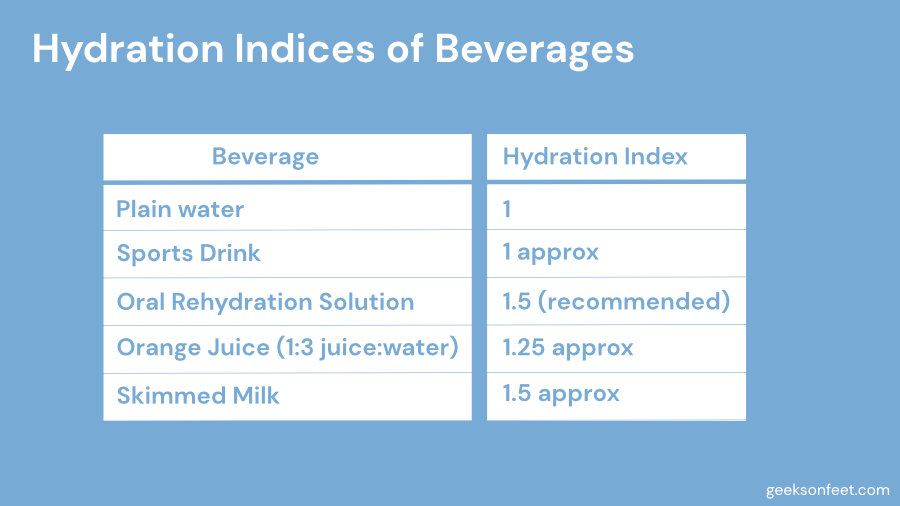
Here is a table that can help you choose the appropriate hydration.
Closing Notes
If you are a running enthusiast, follow us on our social media channels @geeksonfeet on Twitter, and GeeksOnFeet on Instagram and Facebook for updates.
We put substantial time and resources into bringing this content to India's running community. If you like what we do, consider chipping in — every bit helps keep the lights on.